Sibera

Sibera

Monday, May 18, 2015

Blog Post 4


"THE HAMMER BANGED reveille on the rail outside camp HQ at five o’clock as always."

Solzhenitsyn, Aleksandr (2005-03-16). One Day in the Life of Ivan Denisovich: A Novel (Kindle Location 135). Farrar, Straus and Giroux. Kindle Edition. 

This quote expresses time. The end of the quote gives it away. "as always" means that he has done it more than once and that this is not Ivan's first time doing it. Since I have read the end, I see that "as always" means more than 1,000 days, and extreme measure.

The second quote:

There are two ends to a stick, and there’s more than one way of working. If it’s for human beings— make sure and do it properly. If it’s for the big man— just make it look good.

Solzhenitsyn, Aleksandr (2005-03-16). One Day in the Life of Ivan Denisovich: A Novel (Kindle Locations 267-269). Farrar, Straus and Giroux. Kindle Edition. 
This quote tells us that the prisoners have very little power, but when they can, they will resist the guards when they can. They will try their hardest when its for human beings, but when it isn't they just have to make it look good.

historical context- Blog post 3


  1. How did historical events influence the ideas in the novel?  What cultural issues may have influenced, challenged, or inspired the author?

    The day in the Life of Ivan Denisovich, is in fact, a historical fiction. But, according to Shmoop: "Though it's a work of fiction, One Day is set in the very real gulag prison system of the Soviet Union." One example of how the historical events influence the novel:
    "Go to the mess to stack bowls and carry them to the washers-up. You’d get something to eat, but there were too many volunteers, swarms of them. And the worst of it was that if there was anything left in a bowl, you couldn’t help licking it."

    Solzhenitsyn, Aleksandr (2005-03-16). One Day in the Life of Ivan Denisovich: A Novel (Kindle Locations 143-145). Farrar, Straus and Giroux. Kindle Edition. 
    According to Wikipedia: "His experiences at Ekibastuz formed the basis for the book One Day in the Life of Ivan Denisovich." As you can clearly tell, the book was written because of his personal experiences, so the quote above is probably one of the horrible and un-human things he had to do.


    Another example:
    "Because he had eaten only cold food, and gone without his bread ration at breakfast, Shukhov felt emptier than usual.

    Solzhenitsyn, Aleksandr (2005-03-16). One Day in the Life of Ivan Denisovich: A Novel (Kindle Locations 569-570). Farrar, Straus and Giroux. Kindle Edition. 


    Here, we can see how Aleksandr Solzhenitsyn describes Ivan denisovich's shortage of food, and this shortage is in fact, true: "To meet rising demand, prisoners worked longer and longer hours, and on lower food rations than ever before." Wikipedia. The book has a lot of different events from history and is very inspired from it.

lit analysis


How did the author use a particular literary technique (allusion, metaphor, imagery, symbolism, etc.) and what effect does this technique have on the reader?
"There is no worse moment than when you turn out for work parade in the morning. In the dark, in the freezing cold, with a hungry belly, and the whole day ahead of you. You lose the power of speech. You haven’t the slightest desire to talk to each other. Solzhenitsyn, Aleksandr (2005-03-16). One Day in the Life of Ivan Denisovich: A Novel (Kindle Locations 429-431). Farrar, Straus and Giroux. Kindle Edition.
I think we see here in this quote that Denisovich is starving and can't speak no more. The author describes this scene with detail, and goes on to tell us that Denisovich can't speak anymore.

food is like another character in this book. And aside from worrying about keeping warm, food is the primary concern of a zek. Shukhov spends the bulk of the book thinking about food: planning what he's going to eat and when, scheming to get more food, longing for good food, worrying about bad food, etc.


Literary Analysis_Giulia

One Day In The Life of Ivan Denisovich
by Aleksandr Solzhenitsyn 
Week 5: pp. 134-167
 Lit. Analysis
_________________

Answering question:  What theme or themes does the author explore in the novel?  Which passages in the text connect to theme?

 My Presentation:


*sents

________________________________________________

Literary Analysis - Bernardita

Literary Analysis - Bernardita


Throughout the novel, 'One day in the Life of Ivan Denisovich' by Alexander Solzhenitsyn, there are a variety of different themes which are presented in certain ways but the one slight theme which is pretty easy to be found is, the theme of surviving. Through the character of Shukhov, Solzhenitsyn demostrates and shows how humanity can survive even in the harshest and  worst times. In the Stalin labor camp which Ivan was kept for ten long years, was a figure of 'attack to its prisoners' and 'physical and spiritual dignity' as SparkNotes states. From way the beginning the reader can sense how the living conditions there were just pure dreadful and almost intolerable. The outrageous and terrible temperature would lead so low, so cold and with that, barely the prisoners had any clothes to protect nor warm them, even their mattresses have no sheets and plus, there was lack of food.

Another theme which has been discovered through out the novel is the one massive treasure which was highly stolen from the prisoners at the Stalin's labor camp and that would be the slight and precious time wasted, ten or twenty five years of their lives. Everyone is this world of ours deserves at least a little bit of freedom, but the prisoners didn't have much despite the early mornings before their morning roll call or during their meals, which is highly precious and valuable to them. Those slight minutes of freedom, as mentioned before, are highly precious to every single prisoner in there. But it isn't just that it just happens in the Stalin labor camp but also around over globe. People's time have been wasted for nothing and taken for granted. Despite that, in the moment of them having to work or work extra is considered time stolen from them.

Sunday, May 17, 2015

Literary Analysis - Ivanna Hidalgo

Ivanna Hidalgo
One Day in the Life of Ivan Denisovoich by Alexander Solzhenitsyn
Week #5 - Literary Analysis
Pages 134-167
 
To start of with, One Day in the Life of Ivan Denisovich is in chronological order since this book only represents one day in the life of Shukhov (Ivan). In other words, the book doesn't move back and forth between past and present. Secondly, caused to the reason that this book is only expressing one day, there are major details in experiences, opinions, and feelings Ivan had. Further, when something important occurs, Alexander Solzhenitsyn or the narrator expresses from Shukhov's point of view. However, it's hard to tell when Ivan Denisovich is talking and when Alexander Solzhenitsyn is, caused to his narrative technique, called free indirect discourse. In detail, free indirect discourse is a way of writing in which the narrator speaks in third person but shares a character’s private thoughts. As a deeper explanation, the character does not talk, yet the narrator communicates the character's thoughts. An example from the book takes place on page 41, "Writing letters now was like throwing stones into a bottomless pool. They sank without a trace. No point in telling the family which gang you worked in and what your foreman, Andrei Prokofyevich Tyurin, was like. Nowadays you had more to say to Kildigs, the Latvian, than to the folks at home." It explains how Ivan feels, but nothing proves that he is saying it. 

 http://image.slidesharecdn.com/indirectspeech-120412152118-phpapp01/95/indirect-speech-10-728.jpg?cb=1416173485

"Indirect Speech." Indirect Speech. Web. 18 May 2015. <http://www.slideshare.net/jbsaenz/indirect-speech-12518812>. 

Moreover, Alexander Solzhenitsyn might not have chosen to write in free indirect course for a specific reason, but as one sees it, it is just as if there were two brains. In addition, one thinks there are two brains because one person is expressing, but there are two people speaking. In conclusion, this type of writing influences us readers to think diversely and to expand more of what we do not read often.

Literary Analysis- Marina Dissinger

Marina Dissinger
One Day in the Life
Rotation #5
Literary Analysis

  1. What theme or themes does the author explore in the novel?  Which passages in the text connect to theme?

The famous novel "One Day in the Life of Ivan Denisovich" contains numerous themes, but the one which seems most present in the novel is Respect. Alexandr became faous in 1962 with the publication of the novel in the leading Soviet leterary journal of the time, Novy Mir (New World).

Respect
Despite the horrible living conditions in the Gulag which they were imprisoned, the prisoners try their best to treat each other with respect and kindness. Although they live in inhumane circumstances, like receiving only 200 grams of bread per day (Solzenhenitsyn, 17), and sleeping in flat mattresses with holes in them (Solzenhenitsyn, 5), shows that they are able to overcome obstacles for the sake of respect. 
Source
One example is that although the guards call on the prisoners by number, the prisoners themselves do not repeat this action of turning humans into objects, but to respect each other and threat each other equally (Solzenhenitsyn, 14). This is clear in Shukhov’s ability to construct things, whether walls, knives, spoons, or friendships. He maintains his dignity not by openly rebelling against the system that confines him, but rather by living in a civilized manner despite it. Many actions that 
Shukhov takes demonstrates his respect towards things, like when always removes his cap before eating, and forces himself never to hurry through a meal. Unlike Fetyukov, he never begs, instead consistently demonstrating by his own example that it is possible to retain one’s dignity even under the most inhumane and undignified of circumstances.

Literary Analysis; Julianna Mello

 
Source
In this post I would like to talk about Ivan's character, the way he determines things is very interesting. In a way he helps others when it comes to better judgement but always puts himself first in a non-selfish way. This is what helps me connect with the book. Most documents we read this year had stories that we could personally never relate to, but when it comes to characters you will always see yourself in one of them. I love the way Alexander Solzhenitsyn wrote through the present eyes of the protagonist instead of through past experience. I loved exploring One Day in the Life of Ivan Denisovich, it gave me the opportunity to live a life I wouldn't want through words.

Saturday, May 16, 2015

Literary Analysis - Lexi Farnes

Literary Analysis
One Day in the Life of Ivan Denisovich - Alexander Solzhenitsyn
Rotation #5

There are a lot of different themes explored in the novel One Day in the Life of Ivan Denisovich.  The ones that I think are the most important are, power, time and freedom.  

Power
It can be clearly seen in the book that the prisoners don’t have much power.  Even though the prisoners had no power or no choice, lots of the prisoners still have faith.  For instance Shukhov says, “We’ll survive.  We’ll stick it out, God willing, till it’s over” (Solzhenitsyn 141).  The people that do have a lot of power are the guards.  They tell the prisoners what to do and they can do whatever they want.  “Things aren't and never will be fair in the prison camp, and those with even the smallest amount of power often abuse it” (shmoop).

Power-Outage.jpg

Time
The prisoners have barely any personal time and a break from work.  “Apart from sleep, the only time a prisoner lives for himself is ten minutes in the morning at breakfast, five minutes over dinner, and five at supper” (Solzhenitsyn 16).  “Days are already nearly never-ending in the camp. All the days seem to run together into endless prison sentences and non-stop work, with no personal time at all” (shmoop).  All the prisoners wish for more time for themselves, but their wish is never granted.  
no-time.jpg

Freedom
Just like power and time, the prisoners don’t have much freedom also.  They basically sleep, eat and work, that’s it!  “Shukhov gazed at the ceiling in silence.  Now he didn’t know either whether he wanted freedom or not.  At first he’d longed for it.  Every night he’d counted the day of his stretch, how many had passed, how many were coming.  And then he’d grown bored with counting.  And then it became clear that men like him wouldn’t ever be allowed to return home, that they’d be exiled.  And whether his life would be any better there than here, who could tell?  Freedom meant one thing to him, home” (Solzhenitsyn 163-164).  
no-freedom-of-choice.jpg


Literary Analysis - Sophia Takahashi

Freedom  Right


Sophia Takahashi - Literary Analysis
One Day in the Life of Ivan Denisovich - Pages 167-178 (Afterword)
Alexander Solzhenitsyn
Rotation #5 (Final Rotation)


Hope/Faith

One must keep faith and hope when stuck in a jail cell - if hope is lost, you basically lose the will to keep on surviving until you're free. Shukhov clearly has hope, as shown in page 41, "And Shukhov wife nursed the strong hope that when Ivan returned he too would become one of those painters (Solzhenitsyn 41)," where Shukhov/his wife talks about Ivan coming back home to work again. Ivan 'dreams' of coming back home to his family - which gives him faith. If he had nothing to come back to, would he even try?


Freedom (or lack of)

Freedom (or lack of) is an essential theme in this novel. The book itself is about a Day in the Life of a gulag prisoner in Soviet Union. One Day in the Life of Ivan Denisovich portrays Shukhov's life in a gulag prison, where he is made to be a 'slave'. 


He is basically chained up on himself, where there's no way out. Forced to work for his superiors, he is left without any freedom. While he doesn't have freedom nor right, he has no say and his voice/belief is silenced. 

Power (or lack of)

You can see that Shukhov has no power: no power over his voice, opinion and belief. All the prisoners are silenced due to them being inferiors. The guards/the guard's leader's hold all the power, when the prisoners have none at all. In One Day in the Life of Ivan Denisovich, Ivan's food, and materials are depended on what the guards give them: if they have more food or less, etc.

Equality

Equality is clearly lacked in this book for important reasons. First of all, you can see great differences between the guards and the prisoners, where there's no equality, since one is more superior than the other. 


Literary Analysis - Gabriela Campos

One Day in the Life of Ivan Denisovich
Aleksandr Solzhenitsyn
Pages 134-167
Literary Analysis

A Tale of Dark Humour and Bread

One Day in the Life of Ivan Denisovich is an exquisitely written novel by Aleksandr Solzhenitsyn. The book's main goal is to allow the reader to immerse themselves into a Stalinist work camp during the 1940s and spend an entire day there. As one easily learns after reading the piece, the convicts at these camps worked in horrid conditions in extreme weather. They are also daily victims of extreme hunger, fatigue and have no trouble whatsoever falling ill - which Solzhenitsyn brilliantly describes through the use of several literary techniques and by flawlessly exploring certain themes.

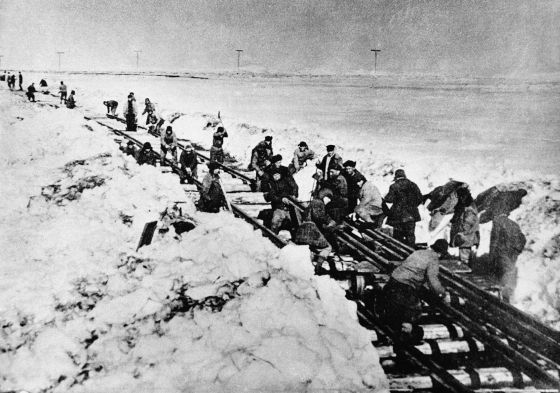
Convicts from a Stalinist gulag working on a railroad


The most highlighted theme throughout the novel is undoubtedly the undying hunger. Solzhenitsyn doesn't hesitate to describe how our protagonist, Shukov's, belly "is an ungrateful wretch, it never remembers past favors, it always wants more tomorrow" (Solzhenitsyn 165). Not to mention that there are constant mentions of the extra loaf of bread Shukov carried around with him and how hard he worked to hide it by sowing hidden patches in his clothes, hiding it in his mittens, etc. Following, the author also writes about how our protagonist had a reasonably lucky day, due to the fact that his group got dinner first and quickly and that a fellow inmate gave him an extra loaf of bread as a thank you. Evidently, hunger was indeed a theme in which Solzhenitsyn decided to explore deeply.
A loaf of bread


Another theme one can notice as they read is humor or irony. Life in a Stalinist gulag was irrefutably miserable, filled with perilous tasks, an undying hunger and a feeling of vast emptiness. However, as once can see in the passages "104, form up in fives," Pavlo shouted down at them. "And you make way there, friends!" and  "The friends would be hanged first." (Solzhenitsyn 97). Throughout the novel, there are no mentions of our protagonist having any friends, merely of previous conflicts with other inmates. That is why, the mention of 'friends' can be considered some kind of a dark humour, since they are merely convicts with the same amount of luck anyone else has, in a place where nearly every character is either freezing, starving, sleep depreived, etc.

Concluding, these, while they are far from being the only themes present in Solzhenitsyn's controversial piece, are some of the ones which stood out the most. Without the hunger being so vastly explored and so dramatically described, the reader would not have believed that life in the gulag was so miserable and without Shukov's dark humour, we would be stuck with a protagonist that either a) never ceased to complain or b) never said a word.

Thursday, May 14, 2015

Historical Analysis; Julianna Mello

       
One Day in the Life of Ivan Denisovich was written in November 1962. The book reflects on one day of a Ivan's everyday life. The book was also adapted into an other version in 1970 as well as into a movie(Sparknotes). Ivan is a man trapped at a soviet labor camp explaining and describing what it's like to live through his eyes. He describes the average life of a prisoner that obviously isn't very average. A labor camp is honestly just an interesting way to say slave house.  The prisoners were expected to work for hours everyday, which is why I feel the author likes to accentuate the scenes of when Ivan isn't working. All prisoners were forced into everyday labor, simple yet very tiring things. I feel that the book was very reflective as it made me feel a certain way when lines were said. I would definitely read this book again. 


Tuesday, May 12, 2015

Question Commander - Berni Richards

Question Commander - Week #4 - Bernardita


Bernardino Richards
Week #3 - pp. 106 - 133
Job - Question Commander

To being with the following questions, about the slight chapters I've read so far of the novel, One Day in the Life, which have been upon my head through out these four weeks would be quite relevant to real life thoughts and questions. And these questions are mainly about the concept of the prison and the people whom are being kept there.

Question #1 - 
Through this novel, it kept me thinking of which if the man whom are in prison are they mainly bad people or victims?

In general, the people whom are brought and kept in prison are those whom have committed a crime or so. But that kept me thinking, what about the Leaders, cooks or the guards? Why do they have to suffer through that dreadful cold days, not enough food? Aren't they all in there because of the Stalins Government? Because, whoever is kept or protecting this camp is truly going through a brutal time, fighting the cold days and night and also the lack of food. Even if the leaders end up eating more than the rest, it still isn't really a normal everyday life. But as mentioned on my first blogpost, what is a normal life routine? Overall, they mainly all work day and night, being forced by the Stalin's government ways and punishments. Is that really fair?

Questions #2 -
How does the government, whom controls the camp expects that the prisoners will change through out their time being?

People whom are brought to these types of camps, are brought there to be changed or to learn their lesson for terrible things they've done in their past. There are huge quantities of people who after being kept there, change, but sometimes don't. Even in normal life, when people do something bad, they don't change after that even though they highly know what they have done was bad. It normally depends on the person, but it's best to change and to be accepted or qualified as a good person, not bad. Their way of thinking changes through out time by specific punishments, but how do the guards know that these people won't end up doing the same terrible things as before? What do you believe?

Moving into more about the novel, One day in the Life -

Question #3 -
Who do you believe that the author is putting in too much about the concept about food or meals through out the novel?

To being, my thoughts to this question, is that I believe the concept of the author for bringing up the topic, 'food' or 'meal' is to us to see how it really is and what is going on in these labor camps. So we can see a slight picture of it. Previously reading about the concept of the cold days and how Ivan wakes up with feeling slight ill, not much comfort to warm him with his temperature, etc. Now the author is moving on to the concept of lack of food. With those two concepts, we get to understand more about the concept of a prisoners life and how its deal is. As read how Ivan hides and scraps pieces of bread, the crusts,  yearning for an extra bowl of oatmeal, or just how Ivan eats his meal. You start to think about how grateful and thankful with the amount of food you receive daily, much more than a slight piece of bread. People around the globe suffer of starvation everyday and we sometimes just take it for granted. Are you grateful?

Sunday, May 10, 2015

Illustrious Artist- Marina Dissinger

Marina Dissinger
Illustrious Artist
Rotation #4
I chose to draw two hands handcuffed together (notice that the cuffs are locked) because one of the main themes in the book is the endurance of humanity. Through the character of Shukhov and his actions, Solzhenitsyn demonstrates that humanity can survive the harshest conditions given. Shukhov and his fellow prisoners maintain their humanity through small acts and rituals. An example of these rituals is removing one's hat at a meal, as shown on page 16. Another is on page 14, which is refraining from licking empty bowls. Concluding, the book demonstrated numerous examples in which endurance of humanity is represented or shown.

Connection Captain_Giulia

One Day in The Life of Ivan Denisovich by Aleksandr Solzhenitsyn
Giulia Di Bella
Week #4
Pages 106-133
Block 1.6
05/10/2015

Scene from the book:  

         Actually, the connection I am about to make, does not really come from a scene, it comes more from the plot or theme of the book. I feel like One Day in the Life, connects to another book, Animal Farm, because although both have a very different plot and story idea, they have one thing in common... both themes eventually roam back to this idea of communism or dictatorship from a higher class of society or community.
         In the book we are currently reading, we can see that the prisoners don't really have a say in the book and don't get much alternatives when it comes to personal choice or ideas. The prisoners just follow what the guards say because it's a life or death matter. By that, I mean that whatever they do, it is extremely important that they do so and do it right, otherwise their lives could even come at risk. The prisoners just followed, obeyed naturally, and never questioned about things directly to the guards. Even though they might have thought about certain questions or topics to ask, they never really had the nerves to share their idea out loud. The prisoners where so scared of the guards that they just basically gave up in trying to fight to survive that they just simply gave in, and lived on the guards' own laws.
         This fits perfectly in the ideas of the book Animal Farm, because in Animal Farm, the animals such as the sheep, the horses, the birds and etc... would only follow the pigs orders and instead of fighting for their own rights or opinions, they just simply gave in because they thought it was not worth the conflict, and also because they were completely brainwashed by the new source of power; the pigs. Since things were fine, why question or argue, or bring things back to how they were? Everything was fine and "better", as far as they were concerned. There was no point, right, but the animals did not notice that a great part of them was being ripped off of each and every one of them; their individualities, uniquenesses, opinions, differentials, and much more. They just became all the same and indifferent, all just animals of the same farm working hard to satisfy their same leader.       
         The connection between One Day in The Life of Ivan Denisovich and Animal Farm, is that both have this idea of a greater power leading over a larger, but weaker, group of people that changed and manipulated them only to remain in power. In the Ivan Denisovich book, the guards rule over the prisoners, obviously, and in Animal Farm, the pigs ruled over the rest of the animals, and my connecti0n as you all could probably see, was the similarity of themes between these two completely different, however similarly plotted books.

http://www.google.com.br/url?sa=i&rct=j&q=&esrc=s&source=images&cd=&ved=0CAQQjBw&url=http%3A%2F%2Fd20eq91zdmkqd.cloudfront.net%2Fassets%2Fimages%2Fbook%2Flarge%2F9780%2F4515%2F9780451531049.jpg&ei=21JRVfjEOdDjsAT274HIBg&bvm=bv.92885102,d.cWc&psig=AFQjCNHDAzyGPdxXYKYaOxZwkApVFG-7Uw&ust=1431479383780542
http://fifthroundmovement.com/wp-content/uploads/2012/08/Animal_Farm_Poster.jpg
https://blogger.googleusercontent.com/img/b/R29vZ2xl/AVvXsEhpMUpR8bp4DI9N_DTpSg5o6EKL7sTsZ_HdPGCgmHogOPpPM-tzPWDz9zosJCfO0BtGl8cwGoJqXxnY5Rz_3A8QcAygpgw2jChXwpFs6zIz5eyFItaOMTROoX-p7QGRSkcm3CVQafU4rboZ/s1600/aleksandr.png


Ivanna Hidalgo - Risk Taking Researcher


Ivanna Hidalgo - Risk Taking Researcher
Week 4 - Pages 133 - 167
One Day in the Life of Ivan Denisovich by Alexander Solzhenitsyn

Firstly, Alexander Solzhenitsyn obviously took a big part in this book not because he wrote it, but because he has certain connections with the book and its characters. Therefore, Alexander Solzhenitsyn's background is needed in order to look at the entire story behind Ivan Denisovich, the primary character, as well as other characters.

Solzhenitsyn was born on December 11th of the year 1918, in Kislovodsk, Russia. His life ended on August 3rd of the year 2008 ("Aleksandr Solzhenitsyn - Biography - Author, Educator, Activist"). 

 In this image, Alexander seems a sorrowed man, but reflects his wise knowledge and personality.
http://nationalvanguard.org/wp-content/uploads/2014/12/Alexander-Solzhenitsyn.jpg
Some of Alexander's occupations in life were to be a novelist, soldier, and teacher. Something that I noticed about all of these three occupations is that they all require a great amount of knowledge. In other words, in order to be a novelist, in different words a writer, one has to be experienced in intriguing your readers in your writing, but still making the book about something that you would be interested in. As once wise Maya Angelou stated, “there is no greater agony than bearing an untold story inside you” (GoodReads). This quote relates to Alexander Solzhenitsyn and his way of writing because as a novelist, he writes his books about his story; however he puts it in different perspectives for the readers. As another point, being a soldier requires training, practice, and even academic knowledge. These types of people need to be great problem solvers because when they're in crises, they will need to stand up. Further, with most reason, a teacher needs to know what to teach, whether its history, math, science or any other practice such as being a sport coach. One the other side, they need to know how to teach because how will their students be interested on a topic a teacher doesn’t really interest in anyways? Now, these all relate to Alexander Solzhenitsyn because it tells us that he used his knowledge as the most important concept to write his book, One Day in the Life of Ivan Denisovich
 
 http://static01.nyt.com/images/2008/02/26/timestopics/carter-395.jpg

We are coming to the conclusion of how this book was written. Well, Alexander Solzhenitsyn had a history that affected the ways and reasons of One Day in the Life of Ivan Denisovich. One Day In the Life of Ivan Denisovich was impacted by Solzhenitsyn's historical background because he was put to service in a Siberian labor camp for 8 years caused to a letter that contained critical information about Stalin.  
http://gdb.rferl.org/A4A8CEBF-F054-42FB-AF91-DC2A34C1CDB8_w640_s.jpg

Alexander got his freedom back in the year of 1953. At first he wrote for because he wanted to do this for himself, afterwards on the year 1962, he published One Day in the Life of Ivan Denisovich (Ivan’s experiences in a prison camp). Furthermore, this book was also the first published story of life in a Soviet labor camp.

 http://travelingbeard.com/wp-content/uploads/2011/08/one-day-in-the-life-of-ivan-denisovich.jpg

Coming to a conclusion, Alexander Solzhenitsyn referred to his past years and started writing One Day in the Life of Ivan Denisovich with some others that related to the Soviet camp labor systems like The Gulag Archipelago ("Aleksandr Solzhenitsyn - Goodreads"). From what it is inferred, Alexander wanted to somehow connect himself to Ivan Denisovich. In detail, Ivan Denisovich is the main/primary character from the One Day in the Life of Ivan Denisovich book. Moreover, Alexander Solzhenitsyn made certain links to some events that happened to him to Shukhov (Ivan). For instance, once Ivan made the decision of saving his bread and not eating any in breakfast (Solzhenitsyn, 17). Finally, this reflects how Alexander many times felt hungry in the stay of his camp. To conclude with, the book One Day in the Life of Ivan Denisovich became some kind of clear reflection on Alexander Solzhenitsyn's life during the times were he stayed in the Siberian labor camps. 


1) "Aleksandr Solzhenitsyn." Goodreads. Web. 03 May 2015. <https://www.goodreads.com/author/show/10420.Aleksandr_Solzhenitsyn>.  

2) Bio.com. A&E Networks Television, Web. 03 May 2015. <http://www.biography.com/people/aleksandr-solzhenitsyn-9488509>.

3) Grossman, Lev. "Remembering Aleksandr Solzhenitsyn." Time. Time Inc., 04 Aug. 2008. Web. 03 May 2015. <http://content.time.com/time/arts/article/0,8599,1829150,00.html>. 

4) "Solzhenitsyn and the Liberals." National Vanguard RSS. Web. 10 May 2015. <http://nationalvanguard.org/2014/12/solzhenitsyn-and-the-liberals/>. 

5)  "Aleksandr Solzhenitsyn." News. Web. 10 May 2015. <http://topics.nytimes.com/top/reference/timestopics/people/s/aleksandr_solzhenitsyn/index.html>.

6) "Fifty Years After 'Denisovich,' Traveling Back To Solzhenitsyn's Gulag." RadioFreeEurope/RadioLiberty. Web. 10 May 2015. <http://www.rferl.org/content/fifty-years-after-denisovich-solzhenitsyn-visit-kazakhstan-former-site-of-gulag-camp-ekibastuz/24779476.html>. 

Illustrious Artist - Sophia Takahashi

Illustrious Artist - Sophia Takahashi

Sophia Takahashi - Illustrious Artist
One Day in the Life of Ivan Denisovich - Pages 133 - 167
Alexander Solzhenitsyn
Rotation #4
#1

#2

#3

For this week's blog post, I decided to make a series of 3 drawings in one. The first drawing shows Ivan Denisovich (Shukhov) in the gulag, clearly trapped (as shown from the book itself: One Day in the Life of Ivan Denisovich). Image #1 is supposed to resemble Shukhov and his life in the gulag, where he basically is in 'torture'. The break in the middle of the image is to show the undefined of the 'other side'.

Image #2 is the transition between what Shukhov doesn't know.

Image #3 shows how the undefined could be freedom: something Ivan hasn't had in a long time. What is freedom for Ivan? Freedom could simply be no work for one day, while for us, students, it could be right to free speech in school. Due to Ivan not experiencing freedom for some time, he might not remember what freedom is itself.

Thursday, May 7, 2015

Line Illuminator - Lexi Farnes

Line Illuminator
One Day in the Life of Ivan Denisovich 
Alexander Solzhenistyn
Rotation #4: pgs 134-167

"The belly is a demon.  It doesn't remember how well you treated it yesterday; it'll cry out for more tomorrow" (Solzheinstyn 142).

The prisoners received barely any food to survive.  And if the prisoners found a bowl with still a little bit in it, they would of course lick it out.  Somedays they got oatmeal that tasted like nothing and somedays got stew, the only good thing about it was that it was hot.  "That bowl of soup--it was dearer than freedom, dearer than life itself, past, present, and future" (Solzheinstyn 126).  "If someone doesn't finish his stew and pushes his bowl back, there are always people hustling to pounce on it, like vultures" (Solzheinstyn 140).  Each prisoner also received a few ounces of bread, and they said that if they got a couple more ounces than they usually do, it ruled their life.  And if the squads had good work reports it meant that they got good rations for a few days.  Even though the prisoners didn't receive like any food, they were still cautious about how they eat it.  "But food gulped down is no food at all; it's wasted; it gives you no feeling of fullness (Solzheinstyn 25).  As you can see, the prisoners cherished their food even though they basically received nothing.

"D'you mean to say you think Old Whiskers will take pity on you?" (Solzheinstyn 146).

Old Whiskers is the name that the prisoners use to refer to Stalin.  Stalin was the leader of the Soviet Union.  "Stalin forced rapid industrialisation and the collectivization of agricultural land, resulting in millions dying from famine while others were sent to camps" (biography).  "The Soviet Union was transformed from a peasant society into an industrial and military superpower.  However, he ruled by terror, and millions of his own citizens died during his brutal reign" (history).

Sunday, May 3, 2015

Historical Context - Gabriela Campos

One Day in The Life of Ivan Denisovich
Aleksandr Solzhenitsyn
Pages 33-68

Solzhenitsyn and the Gulags

Aleksandr Solzhenitsyn, the author of the novel One Day in The Life of Ivan Denisovich is, according to Wikipedia, a widely known critic of Soviet totalitarianism, a writer, former soldier and historian. He, like the protagonist, Shukov, was sent to a Gulag correction camp (commonly known simply as 'Gulag') because of an act of treason. However, Shukov was imprisoned due to a mission he was assigned to by the German intelligence and Solzhenitsyn was imprisoned for writing derogatory comments about the former leader of the Soviet Union, Joseph Stalin, in a letter to a friend (Nobel Prize 2015).

One Day in The Life of Ivan Denisovich is, like the name itself states, a book that narrates the events that occur during a day our protagonist spends at a fictional Gulag in Siberia. This camp is thought to represent the one Solzhenitsyn was sent to in 1950, seeing as the novel states the story takes place in January of 1951 right after the tragic events of WWII had destroyed Russia economically. And while, despite his deteriorating health, Stalin still managed to keep a firm hold on the USSR's communist government (Synonym 2015). This is reflected in the book in an exchange between Shukov and Buynovsky, who jokingly announces a Soviet Decree in page 57.

A Gulag near Moscow in the 1950s

It is also important to note that as Mr. Eric Beck told us in his lecture earlier this year, not much was known about these labour camps. In fact, so little is known that it is still unsure how many people were sent off and how many people died working there, there is only an estimate. And therefore, like those who deny the existence of the Holocaust, many deny the existence of the gulags. 

However, Solzhenitsyn is living proof of their existence, having been imprisoned in one for eight years and known internationally for raising global awareness of the gulag and the Soviet Labour system (Wikipedia 2015). Tirelessly attempting to show the world and tell them about how much more there was to communist USSR until his death in 2008. Nevertheless, one cannot say his mission failed, at least not completely, because One Day in The Life of Ivan Denisovich, along with his many other works have already alerted the world of, if not the existence of gulags, the possibility of their existence.

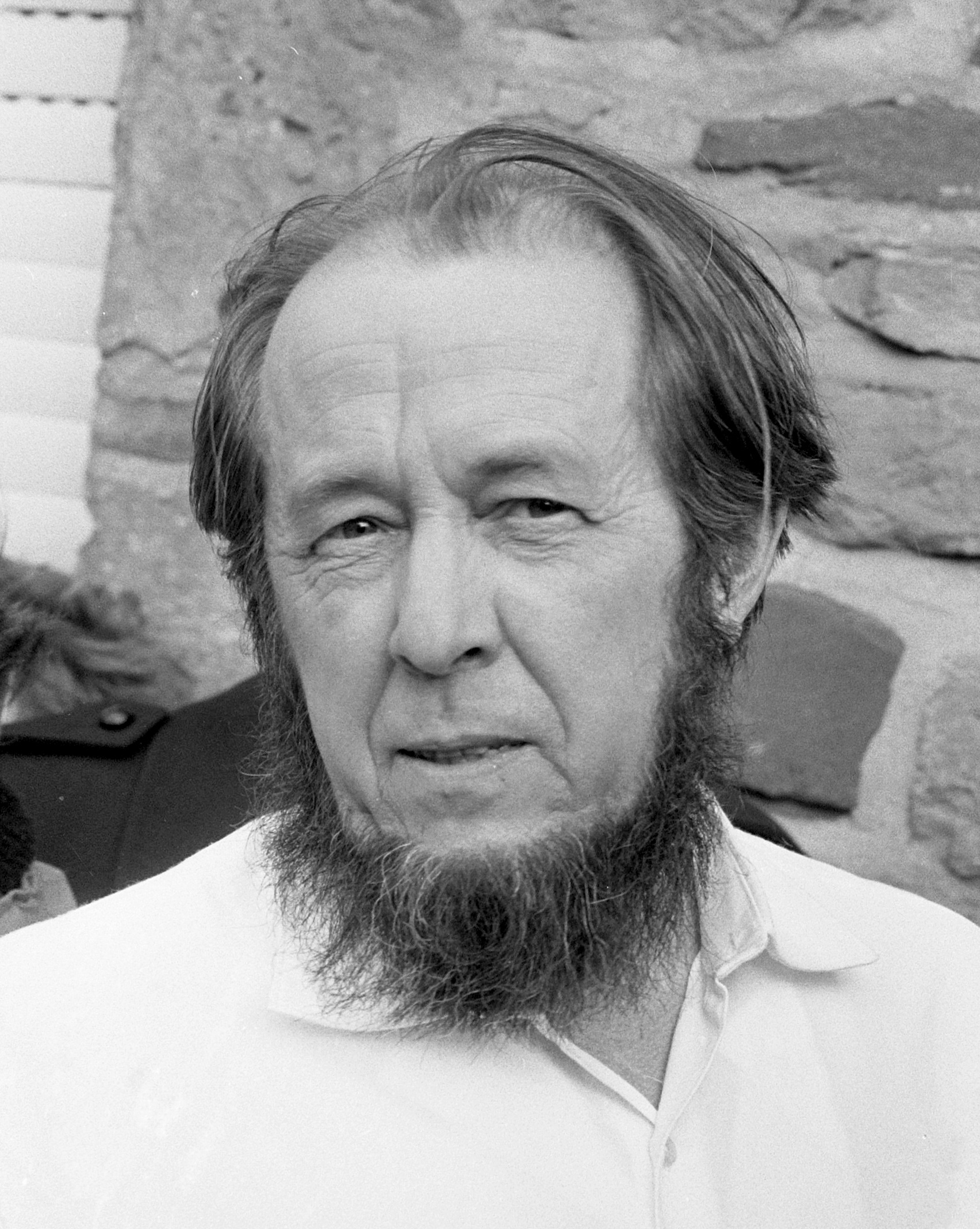
Aleksandr Solzhenitsyn 1974


Marina Dissinger- Historical Context

What is the cultural and educational background of the author and how did this background influence the book?  In what ways do the events in the books reveal evidence of the author’s world view?

    Aleksandr Solzhenitsyn was a Russian author, historian and teacher who witnessed the harsh life in Soviet prison labor camps. He spent eight years in those camps. During the war, between 1944 and 1945, Solzhenitsyn had shared his ideology with his school friend Vitkevich, criticizing Stalin but referring to him with other names, like "Khozyain" and "Balabos" (Wikipedia). Nevertheless, Alexandr was arrested. He was accused of anti-Soviet propaganda. He was beaten and interrogated at Lubyanka prison in Moscow, and was sentenced to eight years of hard labor in 1945 (Russiapedia). Spending the next five months at correctional camps near Moscow, he was forced to work on city building projects. In 1946, because of his intelligence and mathematical competence, he was sent to the Scientific Research Institute in Moscow, where he spent four years. In 1950, Solzhenitsyn was sent to yet another camp, Ekibastuz in Kazakhstan, a camp for political prisoners only, to serve the three years remaining in his sentence. There, he would later use his experiences at the camps to write the widely known book,“One Day in the Life of Ivan Denisovich.”
Source
  This part of Alexandr's life was very prominent, and has a huge contribution to the writing of the book “One Day in the Life of Ivan Denisovich.” The author's cultural background affects the book because it reflects mainly about his experience, and his ideology about the camps. It also influences it because it is an auto- biography, so the book simply expresses the author's point of view about the whole theme, which is of course, the Russian Revolution.
Source
The events in the book reveal some evidence about the author's world view, as he expresses his thoughts about the Russian Revolution. One example is: "During his years in prisons and camps he'd lost the habit of planning for the day, for the day ahead, for supporting his family" (Solzhenitsyn, 41). This passage represents all of the bad things that the camps did to the imprisoned, and how this affected them long- term vise. The quote means, in other words, that a long time in the camps makes the prisoner stop planning ahead and caring about the future.