 |
| Source |
Sibera

Sunday, May 17, 2015
Literary Analysis; Julianna Mello

Saturday, May 16, 2015
Literary Analysis - Lexi Farnes
Literary Analysis
One Day in the Life of Ivan Denisovich - Alexander Solzhenitsyn
Rotation #5


One Day in the Life of Ivan Denisovich - Alexander Solzhenitsyn
Rotation #5
There are a lot of different themes explored in the novel One Day in the Life of Ivan Denisovich. The ones that I think are the most important are, power, time and freedom.
Power
It can be clearly seen in the book that the prisoners don’t have much power. Even though the prisoners had no power or no choice, lots of the prisoners still have faith. For instance Shukhov says, “We’ll survive. We’ll stick it out, God willing, till it’s over” (Solzhenitsyn 141). The people that do have a lot of power are the guards. They tell the prisoners what to do and they can do whatever they want. “Things aren't and never will be fair in the prison camp, and those with even the smallest amount of power often abuse it” (shmoop).
Time
The prisoners have barely any personal time and a break from work. “Apart from sleep, the only time a prisoner lives for himself is ten minutes in the morning at breakfast, five minutes over dinner, and five at supper” (Solzhenitsyn 16). “Days are already nearly never-ending in the camp. All the days seem to run together into endless prison sentences and non-stop work, with no personal time at all” (shmoop). All the prisoners wish for more time for themselves, but their wish is never granted.
Freedom
Just like power and time, the prisoners don’t have much freedom also. They basically sleep, eat and work, that’s it! “Shukhov gazed at the ceiling in silence. Now he didn’t know either whether he wanted freedom or not. At first he’d longed for it. Every night he’d counted the day of his stretch, how many had passed, how many were coming. And then he’d grown bored with counting. And then it became clear that men like him wouldn’t ever be allowed to return home, that they’d be exiled. And whether his life would be any better there than here, who could tell? Freedom meant one thing to him, home” (Solzhenitsyn 163-164).
Literary Analysis - Sophia Takahashi
Freedom ≠ Right
Sophia Takahashi - Literary Analysis
One Day in the Life of Ivan Denisovich - Pages 167-178 (Afterword)
Alexander Solzhenitsyn
Rotation #5 (Final Rotation)
Hope/Faith
One must keep faith and hope when stuck in a jail cell - if hope is lost, you basically lose the will to keep on surviving until you're free. Shukhov clearly has hope, as shown in page 41, "And Shukhov wife nursed the strong hope that when Ivan returned he too would become one of those painters (Solzhenitsyn 41)," where Shukhov/his wife talks about Ivan coming back home to work again. Ivan 'dreams' of coming back home to his family - which gives him faith. If he had nothing to come back to, would he even try?

Freedom (or lack of)
Freedom (or lack of) is an essential theme in this novel. The book itself is about a Day in the Life of a gulag prisoner in Soviet Union. One Day in the Life of Ivan Denisovich portrays Shukhov's life in a gulag prison, where he is made to be a 'slave'.

He is basically chained up on himself, where there's no way out. Forced to work for his superiors, he is left without any freedom. While he doesn't have freedom nor right, he has no say and his voice/belief is silenced.
Power (or lack of)
You can see that Shukhov has no power: no power over his voice, opinion and belief. All the prisoners are silenced due to them being inferiors. The guards/the guard's leader's hold all the power, when the prisoners have none at all. In One Day in the Life of Ivan Denisovich, Ivan's food, and materials are depended on what the guards give them: if they have more food or less, etc.
Equality
Equality is clearly lacked in this book for important reasons. First of all, you can see great differences between the guards and the prisoners, where there's no equality, since one is more superior than the other.

Literary Analysis - Gabriela Campos
One Day in the Life of Ivan Denisovich
Aleksandr Solzhenitsyn
Pages 134-167
Literary Analysis
One Day in the Life of Ivan Denisovich is an exquisitely written novel by Aleksandr Solzhenitsyn. The book's main goal is to allow the reader to immerse themselves into a Stalinist work camp during the 1940s and spend an entire day there. As one easily learns after reading the piece, the convicts at these camps worked in horrid conditions in extreme weather. They are also daily victims of extreme hunger, fatigue and have no trouble whatsoever falling ill - which Solzhenitsyn brilliantly describes through the use of several literary techniques and by flawlessly exploring certain themes.

The most highlighted theme throughout the novel is undoubtedly the undying hunger. Solzhenitsyn doesn't hesitate to describe how our protagonist, Shukov's, belly "is an ungrateful wretch, it never remembers past favors, it always wants more tomorrow" (Solzhenitsyn 165). Not to mention that there are constant mentions of the extra loaf of bread Shukov carried around with him and how hard he worked to hide it by sowing hidden patches in his clothes, hiding it in his mittens, etc. Following, the author also writes about how our protagonist had a reasonably lucky day, due to the fact that his group got dinner first and quickly and that a fellow inmate gave him an extra loaf of bread as a thank you. Evidently, hunger was indeed a theme in which Solzhenitsyn decided to explore deeply.

Another theme one can notice as they read is humor or irony. Life in a Stalinist gulag was irrefutably miserable, filled with perilous tasks, an undying hunger and a feeling of vast emptiness. However, as once can see in the passages "104, form up in fives," Pavlo shouted down at them. "And you make way there, friends!" and "The friends would be hanged first." (Solzhenitsyn 97). Throughout the novel, there are no mentions of our protagonist having any friends, merely of previous conflicts with other inmates. That is why, the mention of 'friends' can be considered some kind of a dark humour, since they are merely convicts with the same amount of luck anyone else has, in a place where nearly every character is either freezing, starving, sleep depreived, etc.
Concluding, these, while they are far from being the only themes present in Solzhenitsyn's controversial piece, are some of the ones which stood out the most. Without the hunger being so vastly explored and so dramatically described, the reader would not have believed that life in the gulag was so miserable and without Shukov's dark humour, we would be stuck with a protagonist that either a) never ceased to complain or b) never said a word.
Aleksandr Solzhenitsyn
Pages 134-167
Literary Analysis
A Tale of Dark Humour and Bread
One Day in the Life of Ivan Denisovich is an exquisitely written novel by Aleksandr Solzhenitsyn. The book's main goal is to allow the reader to immerse themselves into a Stalinist work camp during the 1940s and spend an entire day there. As one easily learns after reading the piece, the convicts at these camps worked in horrid conditions in extreme weather. They are also daily victims of extreme hunger, fatigue and have no trouble whatsoever falling ill - which Solzhenitsyn brilliantly describes through the use of several literary techniques and by flawlessly exploring certain themes.
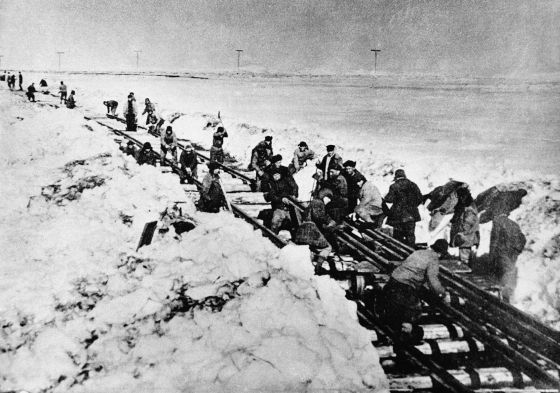
Convicts from a Stalinist gulag working on a railroad
The most highlighted theme throughout the novel is undoubtedly the undying hunger. Solzhenitsyn doesn't hesitate to describe how our protagonist, Shukov's, belly "is an ungrateful wretch, it never remembers past favors, it always wants more tomorrow" (Solzhenitsyn 165). Not to mention that there are constant mentions of the extra loaf of bread Shukov carried around with him and how hard he worked to hide it by sowing hidden patches in his clothes, hiding it in his mittens, etc. Following, the author also writes about how our protagonist had a reasonably lucky day, due to the fact that his group got dinner first and quickly and that a fellow inmate gave him an extra loaf of bread as a thank you. Evidently, hunger was indeed a theme in which Solzhenitsyn decided to explore deeply.
A loaf of bread
Another theme one can notice as they read is humor or irony. Life in a Stalinist gulag was irrefutably miserable, filled with perilous tasks, an undying hunger and a feeling of vast emptiness. However, as once can see in the passages "104, form up in fives," Pavlo shouted down at them. "And you make way there, friends!" and "The friends would be hanged first." (Solzhenitsyn 97). Throughout the novel, there are no mentions of our protagonist having any friends, merely of previous conflicts with other inmates. That is why, the mention of 'friends' can be considered some kind of a dark humour, since they are merely convicts with the same amount of luck anyone else has, in a place where nearly every character is either freezing, starving, sleep depreived, etc.
Concluding, these, while they are far from being the only themes present in Solzhenitsyn's controversial piece, are some of the ones which stood out the most. Without the hunger being so vastly explored and so dramatically described, the reader would not have believed that life in the gulag was so miserable and without Shukov's dark humour, we would be stuck with a protagonist that either a) never ceased to complain or b) never said a word.
Thursday, May 14, 2015
Historical Analysis; Julianna Mello

One Day in the Life of Ivan Denisovich was written in November 1962. The book reflects on one day of a Ivan's everyday life. The book was also adapted into an other version in 1970 as well as into a movie(Sparknotes). Ivan is a man trapped at a soviet labor camp explaining and describing what it's like to live through his eyes. He describes the average life of a prisoner that obviously isn't very average. A labor camp is honestly just an interesting way to say slave house. The prisoners were expected to work for hours everyday, which is why I feel the author likes to accentuate the scenes of when Ivan isn't working. All prisoners were forced into everyday labor, simple yet very tiring things. I feel that the book was very reflective as it made me feel a certain way when lines were said. I would definitely read this book again.
%2520forcedlabor%2520camp.jpg&container=blogger&gadget=a&rewriteMime=image%2F*)


%20forcedlabor%20camp.jpg)
Tuesday, May 12, 2015
Question Commander - Berni Richards
Question Commander - Week #4 - Bernardita
Bernardino Richards
Week #3 - pp. 106 - 133
Job - Question Commander
To being with the following questions, about the slight chapters I've read so far of the novel, One Day in the Life, which have been upon my head through out these four weeks would be quite relevant to real life thoughts and questions. And these questions are mainly about the concept of the prison and the people whom are being kept there.
Question #1 -
Through this novel, it kept me thinking of which if the man whom are in prison are they mainly bad people or victims?
 In
general, the people whom are brought and kept in prison are those whom
have committed a crime or so. But that kept me thinking, what about the
Leaders, cooks or the guards? Why do they have to suffer through that
dreadful cold days, not enough food? Aren't they all in there because of
the Stalins Government? Because, whoever is kept or protecting this
camp is truly going through a brutal time, fighting the cold days and
night and also the lack of food. Even if the leaders end up eating more
than the rest, it still isn't really a normal everyday life. But as
mentioned on my first blogpost, what is a normal life routine? Overall,
they mainly all work day and night, being forced by the Stalin's
government ways and punishments. Is that really fair?
In
general, the people whom are brought and kept in prison are those whom
have committed a crime or so. But that kept me thinking, what about the
Leaders, cooks or the guards? Why do they have to suffer through that
dreadful cold days, not enough food? Aren't they all in there because of
the Stalins Government? Because, whoever is kept or protecting this
camp is truly going through a brutal time, fighting the cold days and
night and also the lack of food. Even if the leaders end up eating more
than the rest, it still isn't really a normal everyday life. But as
mentioned on my first blogpost, what is a normal life routine? Overall,
they mainly all work day and night, being forced by the Stalin's
government ways and punishments. Is that really fair?Questions #2 -
How does the government, whom controls the camp expects that the prisoners will change through out their time being?
 People
whom are brought to these types of camps, are brought there to be
changed or to learn their lesson for terrible things they've done in
their past. There are huge quantities of people who after being kept
there, change, but sometimes don't. Even in normal life, when people do
something bad, they don't change after that even though they highly know
what they have done was bad. It normally depends on the person, but
it's best to change and to be accepted or qualified as a good person,
not bad. Their way of thinking changes through out time by specific
punishments, but how do the guards know that these people won't end up
doing the same terrible things as before? What do you believe?
People
whom are brought to these types of camps, are brought there to be
changed or to learn their lesson for terrible things they've done in
their past. There are huge quantities of people who after being kept
there, change, but sometimes don't. Even in normal life, when people do
something bad, they don't change after that even though they highly know
what they have done was bad. It normally depends on the person, but
it's best to change and to be accepted or qualified as a good person,
not bad. Their way of thinking changes through out time by specific
punishments, but how do the guards know that these people won't end up
doing the same terrible things as before? What do you believe?Moving into more about the novel, One day in the Life -
Question #3 -
Who do you believe that the author is putting in too much about the concept about food or meals through out the novel?
 To
being, my thoughts to this question, is that I believe the concept of
the author for bringing up the topic, 'food' or 'meal' is to us to see
how it really is and what is going on in these labor camps. So we can
see a slight picture of it. Previously reading about the concept of the
cold days and how Ivan wakes up with feeling slight ill, not much
comfort to warm him with his temperature, etc. Now the author is moving
on to the concept of lack of food. With those two concepts, we get to
understand more about the concept of a prisoners life and how its deal
is. As read how Ivan hides and scraps pieces of bread, the crusts,
yearning for an extra bowl of oatmeal, or just how Ivan eats his meal.
You start to think about how grateful and thankful with the amount of
food you receive daily, much more than a slight piece of bread. People
around the globe suffer of starvation everyday and we sometimes just
take it for granted. Are you grateful?
To
being, my thoughts to this question, is that I believe the concept of
the author for bringing up the topic, 'food' or 'meal' is to us to see
how it really is and what is going on in these labor camps. So we can
see a slight picture of it. Previously reading about the concept of the
cold days and how Ivan wakes up with feeling slight ill, not much
comfort to warm him with his temperature, etc. Now the author is moving
on to the concept of lack of food. With those two concepts, we get to
understand more about the concept of a prisoners life and how its deal
is. As read how Ivan hides and scraps pieces of bread, the crusts,
yearning for an extra bowl of oatmeal, or just how Ivan eats his meal.
You start to think about how grateful and thankful with the amount of
food you receive daily, much more than a slight piece of bread. People
around the globe suffer of starvation everyday and we sometimes just
take it for granted. Are you grateful?Sunday, May 10, 2015
Illustrious Artist- Marina Dissinger
Marina Dissinger
Illustrious Artist
Rotation #4

Subscribe to:
Posts (Atom)